Every day, your office consumes water that looks clear but might harbor hidden impurities, microscopic toxins, and metallic sediments. Employees become exposed to subtle tap water contaminants, which can be threatening to their health.
A Reverse Osmosis (RO) water dispensing system provides an effective solution by removing contaminants from your drinking water. It’s a filtration process that pushes water through a semi-permeable membrane to strip out contaminants most filters miss.
Understanding what a reverse osmosis system is in depth can completely transform how your workspace handles daily hydration.
This guide breaks down how it works, what it removes, and the benefits your office will experience after switching to it. You will learn the components inside a real system, the contaminants it targets, and how to pick the right one for your workplace.
Read this till the end before investing in an RO water dispensing system.
What Is a Reverse Osmosis (RO) System?
A reverse osmosis water filtration system forces tap water through a tightly woven membrane under pressure. That membrane blocks particles, chemicals, and dissolved solids that regular carbon filters let pass through.
What’s left is water stripped of nearly everything except H2O itself. Office dispensers pair this membrane with pre- and post-filters, delivering clean water straight from your existing plumbing line. There is no bottle to lift and no tank to refill by hand.
It’s the same core technology used in bottled water plants, just built into a countertop or under-counter unit for daily office use.
How Does a Reverse Osmosis System Work?
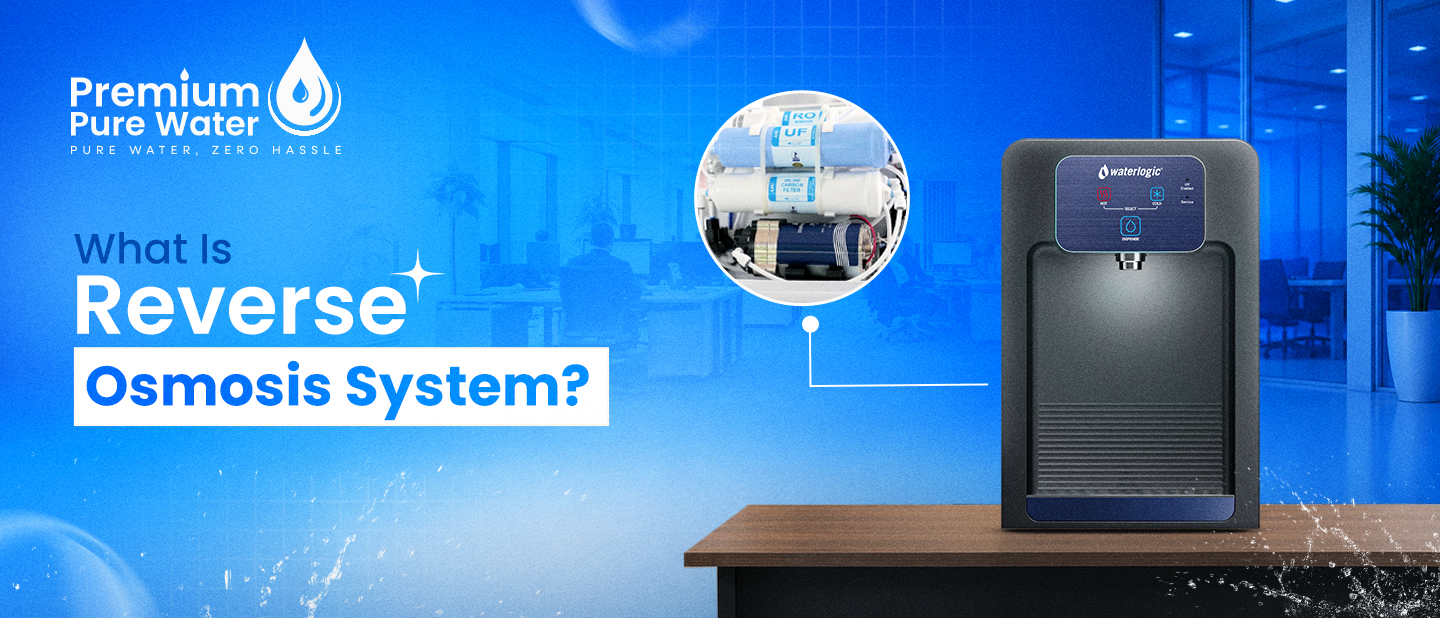
Every reverse osmosis system follows a carefully designed filtration process to maximize water purity and safety. The entire RO process in an office water dispenser runs automatically. All your team has to do is press a button for clean water on demand:
- Water enters the unit and passes through a sediment filter first, catching dirt, rust, and larger particles.
- Next, a carbon filter absorbs chlorine, odors, and organic compounds that affect taste.
- The pre-filtered water then hits the RO membrane, where pressure forces it through microscopic pores.
- Contaminants too large to pass get flushed down a separate drain line as wastewater.
- The purified water then moves into a storage tank, ready for instant dispensing.
- Some units add a final carbon polish before the water reaches the tap, sharpening the taste.
Components of a Reverse Osmosis System
Commercial filtration units require several specialized internal components working in perfect harmony to produce premium drinking water. Each specific part plays a critical role in purifying, protecting, and storing your daily corporate water supply:
Sediment Pre-Filter
This initial mechanical barrier captures large physical particles like rust, sand, silt, and dirt from incoming lines. Removing these coarse sediments protects the delicate downstream purification components from premature clogging, mechanical abrasion, and operational damage.
Activated Carbon Pre-Filter
The secondary stage utilizes dense activated carbon blocks to adsorb organic chemicals, agricultural pesticides, and volatile compounds. This critical step eliminates unpleasant chlorine tastes and foul chemical odors. It ensures your office drinking water tastes perfectly crisp.
Semi-Permeable RO Membrane
This advanced composite component serves as the primary core engine of the entire water purification configuration. It filters out microscopic elements down to 0.0001 microns and blocks dissolved salts, heavy metals, and dangerous chemical residues.
Automatic Shut-Off Valve
It’s a smart mechanical component that monitors internal pressure levels to control the flow of incoming tap water automatically. The valve stops the purification process completely once the storage tank reaches maximum capacity. It’s an exceptional way to reduce water waste.
Storage Tank
Purified water collects here under pressure, ready for instant use. The tank ensures your dispenser delivers water immediately instead of making you wait. If you run a larger office, you may need bigger tanks to handle peak demand.
Post-Carbon Filter
Before water reaches the dispensing nozzle, it passes through a final polishing carbon filter for taste refinement. In this final stage, any remaining trace tastes or odors that might develop during internal tank storage are eliminated.
What Contaminants Does Reverse Osmosis Remove?
Advanced pressure filtration in a water dispenser acts as an absolute barrier against several invisible environmental water hazards. Deploying a reverse osmosis system for the office ensures your team remains completely safe from these municipal pipe contaminants:
Lead and Heavy Metals
Aging municipal plumbing infrastructure can leach dangerous heavy metals directly into your daily office drinking supply. RO filtration setup completely removes lead, copper, and arsenic. Invest in one to protect your workforce from chronic neurological health hazards.
Dissolved Inorganic Salts
High concentrations of magnesium, calcium, sodium, and sulfates can make your workplace drinking water taste brackish. The specialized membrane blocks these dissolved salts completely. The dispenser then yields incredibly soft, clean, and refreshing water for everyone.
Chemical Fluoride
While municipalities add fluoride to protect teeth, excessive concentrations can alter the taste of your drinking water. The microscopic filtration membrane consistently reduces fluoride levels. It keeps your office water profile perfectly balanced and clean.
Volatile Organic Compounds
Industrial runoff and agricultural pesticides can accidentally leach into local groundwater tables and municipal reservoir systems. Advanced carbon stages break down these hazardous volatile organic chemicals. Be able to eliminate toxic carcinogens before they reach cups.
Microplastics and Particulates
Degrading synthetic materials and environmental plastic pollution now contaminate almost all municipal tap water sources nationwide. The tight molecular mesh in an RO system traps microplastic fibers effortlessly. It keeps your synthetic debris out of your employee hydration breakrooms.
Why Do You Need a Reverse Osmosis System?
Standard tap water and basic filters leave gaps that only RO technology can close. Offices handling high foot traffic or health-conscious employees need a filtration method they can fully trust.
Here is why an RO-enabled water dispenser makes complete sense for your workplace.
Health Protection for Your Team
Employees drink water throughout the day, and contaminant exposure adds up over time. An RO system for office use gives everyone consistent, tested water quality. That protection builds real trust in your workplace amenities and boosts their morale.
Better Taste Means More Hydration
People drink more water when it actually tastes good, plain and simple. RO removes the chlorine and mineral taste that makes tap water unpleasant. Better hydration can support focus, energy, and fewer afternoon slumps across your team.
Consistent Water Quality Year-Round
Municipal water quality can shift with seasons, treatment changes, or infrastructure issues nearby. An RO system filters consistently regardless of what’s happening upstream. You and your team get the same clean result every single day.
Reduced Reliance on Bottled Water
Bottled water costs add up fast, and storage becomes a real logistical headache. RO dispensers connect directly to your plumbing, delivering unlimited water without deliveries. That means fewer trucks, and bottleless water drinking, which leads to steadier monthly costs.
Benefits of a Reverse Osmosis System
Beyond contaminant removal, RO systems bring practical advantages that affect your daily operations and bottom line. These benefits compound over time, which in turn makes the investment worthwhile for most commercial spaces.
Your business can gain total control over your hydration quality while eliminating ancient administrative logistics.
Take a look at the key benefits below:
Lower Long-Term Costs
A monthly service fee replaces unpredictable bottled water invoices and delivery surprises. Over a year, most offices spend noticeably less on water. Maintenance and filter changes stay bundled into one predictable payment.
No More Heavy Lifting
Nobody has to haul, store, or swap out 5-gallon jugs anymore. That eliminates a genuine workplace safety concern for smaller teams. Your staff gets their storage space and time back immediately.
Environmental Impact Reduction
Cutting single-use plastic bottles supports sustainability goals many companies now track closely. Fewer delivery trucks also means a smaller transportation footprint. This helps with Environmental, Social, and Governance (ESG) reporting and genuine environmental responsibility.
Improved Employee Satisfaction
Clean, great-tasting water is a small perk that your staff will notice and appreciate daily. It signals that you care about workplace comfort and wellbeing. Small amenities like an RO-enabled water dispenser can add up to real retention value.
Types of Reverse Osmosis Systems
Not every RO system fits every office. Hence, manufacturers build different configurations for different needs. Knowing the differences helps you choose equipment that matches your team size and water demand.
These are the 3 most common types of RO systems.
5-Stage Reverse Osmosis
A 5-Stage RO is the standard configuration most offices choose. It combines sediment, carbon, and RO membrane filtration. The technology removes the widest range of contaminants while staying compact enough for countertop or under-counter installation.
It’s a reliable, cost-effective commercial reverse osmosis system for small to mid-sized teams that need dependable daily performance. There is no excessive equipment footprint or complexity, and it is often the best reverse osmosis system for office spaces.
For example, the WL30 dispenser offers 5-Stage Reverse Osmosis or 4-stage Micro-Filtration as a selectable filtration option. It’s absolutely ideal for small to mid-sized office spaces. The premium setup delivers deeper contaminant removal than standard micro-filtration – all in a compact, space-saving unit.
Long-Life Dual High-Consumption Reverse Osmosis
High-traffic commercial spaces like warehouses, manufacturing hubs, and large hospitals require massive volumes of continuous water daily. The present industrial-grade configuration runs dual membranes simultaneously to double the purification speed and reduce internal system wastewater.
It features heavy-duty internal pumps and extended-life filters designed to withstand intense, non-stop commercial utility demands.
Reverse Osmosis with Mineral Add-Back
Standard RO strips out beneficial minerals along with contaminants, leaving water tasting flat. RO with mineral add-back reintroduces calcium and magnesium after filtration.
A technology like this improves both taste and pH balance. It’s ideal for offices where employees are particular about water taste and mouthfeel throughout the day.
The WL50CT Countertop Water Dispenser is engineered specifically with this technology. When customizing this high-traffic commercial unit, you can explicitly choose this model for high-performance purification.
Reverse Osmosis Vs. Other Water Filtration Methods
Different water filtration methods target different contaminants. However, their effectiveness varies significantly. Comparing them helps determine whether reverse osmosis offers the best protection for your office’s drinking water.
The comparison table below highlights how reverse osmosis performs against other water filtration methods:
| Filtration Method | Contaminants Removed | Maintenance | Best For |
| Reverse Osmosis | PFAS, heavy metals, microplastics, dissolved solids | Filter and membrane changes every 6–24 months | Offices wanting thorough, comprehensive filtration. |
| Carbon Filtration | Chlorine, odor, some organic compounds | Filter changes every 3–6 months | Basic taste improvement, lower contaminant load. |
| UV Filtration | Bacteria and viruses only | Bulb replacement yearly | Disinfection, and not chemical removal. |
| Water Softeners | Calcium and magnesium (hardness) | Salt refills monthly | It prevents scale buildup, but not purification. |
How to Choose the Right Reverse Osmosis System?
Choosing the best office water dispensing system with RO depends on your office size, water usage, and quality concerns. A mismatched system either underperforms or costs more than necessary for your actual needs.
We suggest you consider these factors before deciding:
Assess Your Daily Water Demand
Count your employees and estimate daily consumption to size the system correctly. Small offices need less output capacity than warehouses or busy retail locations. Undersizing may lead to slow dispensing during peak hours.
Check Local Water Quality Reports
Your municipality’s water quality report reveals which contaminants are most relevant locally. It helps you prioritize membrane type and filtration stages accordingly. Some areas need more aggressive Per- and polyfluoroalkyl substances (PFAS) or heavy metal removal.
Compare Maintenance Requirements
You must ask about filter replacement schedules, membrane lifespan, and service visit frequency upfront before getting one. Systems with bundled maintenance plans save you administrative hassle later. With predictable service, you can keep your equipment running at full performance.
Work With a Trusted Local Provider
Choose a provider who installs, services, and stands behind their equipment locally. National chains often lack the responsiveness smaller offices need for quick fixes. Nevertheless, local expertise means better and faster support when something needs attention.
Upgrade Your Office with Cleaner, Safer Drinking Water
Now you know exactly what a reverse osmosis system is and why it matters for your workplace. It’s a practical shift away from bottled water hassles toward consistent, contaminant-free hydration your whole team can rely on. Whether you are dealing with aging pipes, PFAS concerns, or simply tired of managing water jug deliveries, RO technology solves the problem at the source.
Premium Pure Water designs, installs, and services the best reverse osmosis water filtration system setups built for New Jersey offices. We handle everything from sizing to ongoing maintenance. Rest assured knowing you never have to think twice about your water again.
Reach out to Premium Pure Water today for a free consultation and see how effortless clean water can be.
Frequently Asked Questions
What is a reverse osmosis water dispenser?
A reverse osmosis water dispenser is a point-of-use water filtration system, connecting directly to a dedicated faucet or dispenser. It uses reverse osmosis technology to remove dissolved contaminants, heavy metals, chemicals, and other impurities before delivering purified drinking water.
What is the lifespan of a commercial filtration membrane?
A high-quality commercial reverse osmosis system membrane generally lasts between 2 and 3 years before requiring professional replacement. Your local water hardness and daily office usage volumes will ultimately determine the exact replacement timeline.
Does the RO purification method strip out healthy minerals?
Yes, the microscopic membrane removes all dissolved solids, including small trace minerals like calcium and magnesium. Choosing a system with integrated mineral add-back technology easily resolves this issue by restoring healthy, balanced minerals.
What is the best reverse osmosis water dispensing setup for a New Jersey business?
The best reverse osmosis system for office use combines multi-stage purification with built-in UV sanitization. A premium setup like this guarantees your team receives completely pure, safe, and delicious drinking water around the clock.
Is professional installation required for these RO systems?
Yes, installing a reverse osmosis system for office environments requires tapping directly into commercial plumbing lines. Professional installation by certified technicians ensures leak-free operation, correct drainage connections, and validation of your product warranty.